
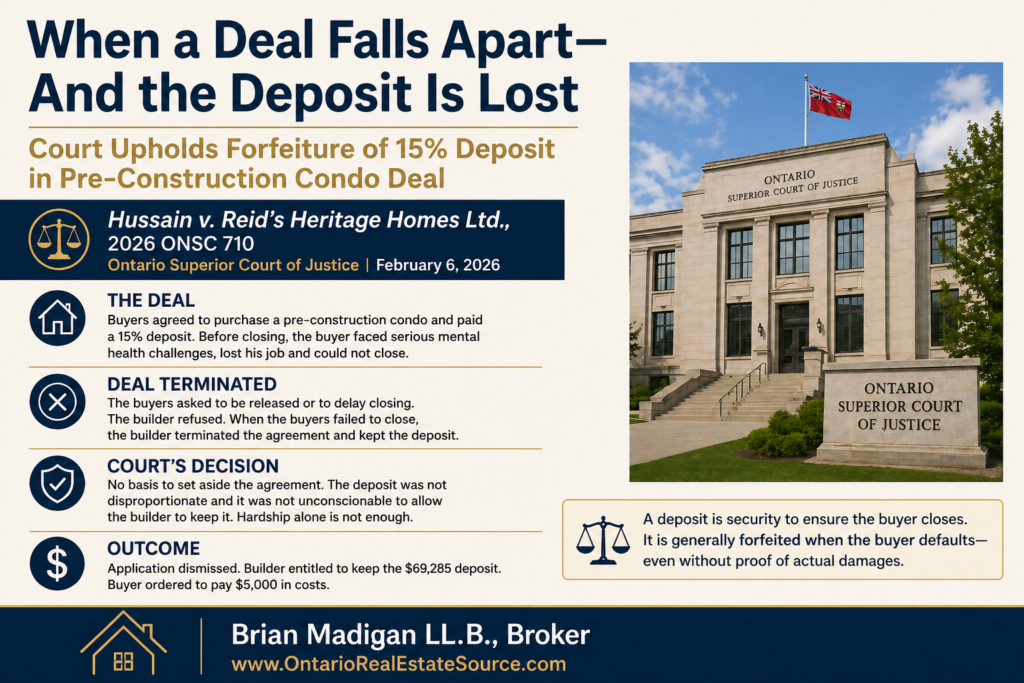
Hussain v. Reid’s Heritage Homes Ltd., 2026 ONSC 710
Real estate transactions do not always fail because of bad faith or sharp practice. Sometimes, they collapse because life takes an unexpected turn in events. The decision in Hussain v Reid’s Heritage Homes Ltd. is a reminder that even genuine personal hardship may not be enough to relieve a Buyer from the consequences of a failed deal.
In this case, the purchaser agreed to buy a pre-construction condominium unit in Kitchener, paying a substantial deposit of just over $69,000, representing 15% of the purchase price. The closing was scheduled several years later, a common feature of pre-construction transactions.
Unfortunately, circumstances changed dramatically. After entering into the agreement, the purchaser experienced:
- serious mental health challenges,
- lost his employment, and
- found himself unable to secure the financing needed to complete the purchase.
As the closing date approached, he asked the builder to either release him from the agreement or extend the closing date.
The builder refused.
When the purchasers failed to close, the builder terminated the agreement and retained the deposit. The purchaser then brought an application seeking to recover that deposit, arguing that it would be unfair and unconscionable for the builder to keep it in light of his circumstances.
The Court disagreed.
Justice Smith began by confirming that there was no basis to set aside the agreement itself. There was no evidence of misrepresentation, fraud, or undue influence. The transaction was an ordinary, arm’s-length real estate deal. Importantly, the builder had no knowledge of the purchaser’s mental health struggles at the time the agreement was signed.
The focus then shifted to the doctrine of relief from forfeiture.
Under Ontario law, Courts have the discretion to relieve against the forfeiture of a deposit but only in limited circumstances. The governing test, as set out in Redstone Enterprises Ltd. v Simple Technology Inc., asks two questions:
- is the deposit disproportionate to the damages suffered, and
- would it be unconscionable to allow the seller to retain it?
On the first question, the Court found that the deposit was not disproportionate. The builder faced real and predictable losses: a declining market, the costs of re-listing the unit, carrying expenses, and the risk of ultimately selling for less. Even though those losses had not yet been precisely quantified, the Court accepted that they were real and could exceed the deposit amount.
On the second and more demanding question of unconscionability, the purchaser’s argument also failed. The Court emphasized that unconscionability is reserved for exceptional cases. Here, there was no inequality of bargaining power, no unfair dealing, and no misconduct. The purchaser was experienced in real estate and had entered into the agreement voluntarily, with the assistance of a real estate agent.
The purchaser’s mental health struggles, while serious and unfortunate, arose years after the agreement was signed. The builder was unaware of those issues at the time of contracting. As the Court noted, hardship alone does not make a bargain unconscionable.
Perhaps most importantly, the decision reinforces the fundamental purpose of a deposit. A deposit is not simply a pre-estimate of damages. It is security, a tangible incentive for the purchaser to complete the transaction. As a result, deposits are generally forfeited when a buyer fails to close, regardless of whether the Seller can prove actual losses.
In the end, the application was dismissed. The builder was entitled to retain the full deposit, and the purchaser was ordered to pay costs.
Buyers should be cautious. Entering into a real estate agreement, particularly a pre-construction contract is a long-term financial commitment. If circumstances change, the law will not easily undo the bargain.
For Sellers and developers, the decision confirms that deposits remain a powerful and enforceable tool. Provided the transaction is fair and properly conducted, Courts will be reluctant to interfere.
The broader lesson is simple but important: the enforceability of a contract is judged at the time it is made not by what happens afterward.
Brian Madigan LL.B., Broker
www.OntarioRealEstateSource.com